Saturday, November 5, 2011

The 5th of November


I just posted my rendition of the famous rhyme on Facebook:

“Remember, remember,
That 'V for Vendetta' (http://bit.ly/sVMFvG)
And the Gunpowder Plot of 1605 (http://bit.ly/tMvLa7)
Are radically different,
Before making assertions
About the 5th of November. (Okay, it's not as catchy as the original)” –Me, 2:02pm CDT, 11/5/2011

I just have a small problem with the modern treatment of this day. I understand the desire to have a powerful symbol, all the better if it is historical, to rally your cause around.

However, one should probably do a little light reading before deciding.

The main issue I have is with the use of the rhyme and the date. The remembrance of the day, historically, is a remembrance of treason. And not the ‘good’ kind of treason (i.e., freedom fighting).

Anyone remember why Guy Fawkes was hanging out in a basement on the morning of November 5th, 1605?

Well, he was there to light the gunpowder stored in the undercroft the conspirators rented, conveniently located directly below the House of Lords. Why did he (and his conspirators) want to blow up the House of Lords while it sat in a session of Parliament?

Largely because the king, King James I, was a protestant, and the conspirators were going to simultaneously kidnap his (9-year-old) daughter, Princess Elizabeth, and install her as a Catholic queen (and presumably their puppet).

The anonymous letter sent to a member of Parliament (4th Baron Monteagle) warning the Catholics to stay away that day, which was dutifully shown to the King, led to the arrest of Guy Fawkes in the basement. (Did you know we call men ‘guys’ because of Guy Fawkes, and that until the term came to America with the colonials it was a derogatory term for sloppily-dressed men?) 

Now, as I said, the movie ‘V for Vendetta’ is what we are actually referencing in modern terms, like when Anonymous wears the Guy Fawkes masks made famous by … the movie. Guy Fawkes (the historical person) was distinctly not wearing a mask. He had no reason to. One of his few admirable traits was that, upon arrest, he basically said, “Yeah, I was gonna blow you a**holes up!” So at least he was proud until he jumped off the gallows to avoid more torture.

My point is that is is odd to me to use the symbols without properly referencing the movie. Obviously, the masks are a blatant movie reference, but then the masks themselves reference Guy Fawkes, and then people get all teary-eyed about how he was executed in his attempt to overthrow tyranny even though that is the furthest from the truth.

As someone who, to the everlasting annoyance of my friends, actually cites works when making assertions in conversation, I find the disregard for history unsettling. Use the symbol, reinvent it, but at least understand what you are doing.

The closest comparison I can think of is “Beware the Ides of March,” which is not remembered as ‘overthrow tyranny via assassination,’ but rather, beware treachery.

Which is exactly the message of the old English rhyme.

Personally, I find the anonymous letter writer more heroic, for preventing senseless violence and death.

RTFM.
QED.

- E

Tuesday, July 19, 2011

The Weakerthans: Sounds Familiar


I love The Weakerthans for the poetry of their songs, and especially the odd rhythms. Perhaps my favorite songs is off their album Fallow (yes, from 1997... so what?). Here’s how any old lyrics site has the lyrics to the song:

We emerged from youth all wide-eyed like the rest. Shedding skin faster than skin can grow, and armed with hammers, feathers, blunt knives: words, to meet and to define and to... but you must know the same games that we played in dirt, in dusty school yards has found a higher pitch and broader scale than we feared possible, and someone must be picked last, and one must bruise and one must fail. And that still twitching bird was so deceived by a window, so we eulogized fondly, we dug deep and threw its elegant plumage and frantic black eyes in a hole, and rushed out to kill something new, so we could bury that too.
The first chapters of lives almost made us give up altogether. Pushed towards tired forms of self immolation that seemed so original. I must, we must never stop watching the sky with our hands in our pockets, stop peering in windows when we know doors are shut. Stop yelling small stories and bad jokes and sorrows, and my voice will scratch to yell many more, but before I spill the things I mean to hide away, or gouge my eyes with platitudes of sentiment, I'll drown the urge for permanence and certainty; crouch down and scrawl my name with yours in wet cement.

Two paragraphs of prose. Which is fine. It’s interesting to see it written that way. Especially when it sounds like this (he’s singing it faster than the album here, too):


Now perhaps you see how this form of the lyrics is not capturing the poetry of the lyrics. So, here is how I laid out the lyrics. My blog is skinny, so I’ve capitalized and bolded new lines.

We emerged from youth all wide-eyed like the rest.
Shedding skin
Faster than skin can grow,
And armed with hammers, feathers, blunt knives: words, to meet and to define and to...
But you must know
The same games that we played in dirt,
In dusty school yards has found a higher pitch and broader scale
Than we feared possible, and someone must be picked last,
And one must bruise and one must fail.
And that still twitching bird was so
Deceived by a window,
So we eulogized fondly, we dug deep and threw
Its elegant plumage and frantic black eyes in a hole,
Then rushed out to kill something new,
So we could bury that too.
The first chapters of lives almost made us give up altogether.
Pushed towards tired forms of self immolation
That seemed so original. I must,
We must never stop
Watching the sky with our hands in our pockets, stop
Peering in windows when we know doors are shut.
Stop yelling small stories and bad jokes and sorrows, and
My voice will scratch to yell
Many more, but
Before I spill the things I mean to hide away,
Or gouge my eyes with platitudes of sentiment,
I'll drown the urge for permanence and certainty;
Crouch down and scrawl my name with yours in
Wet
Cement.

I feel that is much more satisfying written out that way. And about 100 times more interesting. But really, you need to listen to the recording. Try to follow along with the prose version, then try to follow with my poetry version. Interesting, eh?

Friday, March 25, 2011

Cleaning the Garage


We got our dumpster today, which is super exciting. Also, they delivered a 30yd instead of a 20yd, which I guess is an added bonus.

It turned out well, because the crap in the garage took up a lot of space…

I didn’t remember my resolve to take a before picture, as I was super excited to start. Didn’t remember until I was halfway done, so it was moot. However, let me put it this way: a) I’ve made a good dent in a 30 cubic yard dumpster; b) before when you opened the door, all you saw was a sea of trash, couldn’t even walk in.

Here’s some highlights:

  • Old glass storm windows
  • The extra pieces for the ‘new’ gutters, including a ton of connectors
  • The old gutters. And their connectors.
  • 3 lawnmowers and a snowblower.
  • Old TV.
  • LP gas heater.
  • An entire wok set, still in the packaging (I kept that).
  • Many hockey sticks.
  • Clothes hangers. This guy had a problem. We find them everywhere. In this case, even attached to the spring for the garage door.
  • Lots of lumber, the good stuff I’m keeping.
  • 1.5 rear spoilers to an unknown car.
  • An old windshield wiper, in the new wiper’s box.
  • A crate that seemed to be purpose built to hold his old paint can lids.
  • The old garage (?) window.
  • Empty packaging, empty boxes.
  • An ice-hole drill thingy for ice fishing.
  • Lots of little bits of things: tiny pieces of foam insulation (less than 1 sqft), 6inch long pieces of downspout, 1ft long pieces of lumber. What did he expect to do with these things?
  • 6ft long, 1/4”ish thick, 6” wide piece of aluminum. To the scrappers!
  • Some sort of large pavilion-y tent thing.
  • And.. a kitchen sink. No joke.

It seems like whoever it was that packed the majority of this shit in there saved the old broken whatever whenever he replaced something. When we first moved in we got rid of an old dishwasher that was in there, and the dishwasher in the kitchen when we moved in was already from the 80s or 90s. That means the ‘old dishwasher’ sat in that garage for probably 25 years, through at least 2 subsequent owners before we got rid of it.

Wednesday, March 9, 2011

The Right of the People


“We hold these truths to be self-evident, that all men are created equal, that they are endowed by their Creator with certain unalienable Rights, that among these are Life, Liberty and the pursuit of Happiness. — That to secure these rights, Governments are instituted among Men, deriving their just powers from the consent of the governed, — That whenever any Form of Government becomes destructive of these ends, it is the Right of the People to alter or to abolish it, and to institute new Government, laying its foundation on such principles and organizing its powers in such form, as to them shall seem most likely to effect their Safety and Happiness.”

Today, the Wisconsin Senate illegally voted through a bill that removes fundamental rights of the working people.

Today, in Michigan, the Senate passed a bill that allows the governor to declare a state of fiscal emergency (state of emergency law? sound familiar?) that allows the state government to dissolve contracts, dissolve unions, even dissolve town governments, and replace them with a unilateral dictator who can be paid an unlimited salary.

Today, unions (human rights) are under attack in Wisconsin, Michigan, Ohio, Indiana, Idaho, Washington, Alaska, Hawaii, Illinois, Tennessee, the list goes on.

Today, the fundamental rights of people in this country are under attack.

Today, we must exercise the right of the people to alter or abolish the government. We must do whatever we can, peacefully, to stop what the GOP and their cronies are trying to do. They have shown quite clearly that they will not obey the law. They held their votes tonight illegally. They have violated the state constitution to lock (and weld!) entrances to the capitol, denying constituents entrance.

Today, we must work to recall the republicans that are eligible. We must get out the vote in upcoming elections. We must challenge the illegal actions of the current government in courts of law.

Tomorrow, or the next day, when the Governor signs this bill into law, the public workers of the state of Wisconsin must stage a general strike, and all unions that are able must strike in solidarity, and the people must take to the streets, and we must take our government back.

Tuesday, February 22, 2011

This is What Class Warfare Looks Like


“It is time for us all
To decide who we are
Do we fight for the right
To a night at the opera now?
Have you asked of yourselves
What's the price you might pay?
Is it simply a game
For rich young boys to play?
The color of the world
Is changing day by day...

Red - the blood of angry men!
Black - the dark of ages past!
Red - a world about to dawn!
Black - the night that ends at last!”
- Les Miserables

Today’s inspirational quote comes from Les Miserables (the musical), an apt source as you will see.

A favorite chant of protestors against Scott Walker’s attack on unions is “this is what democracy looks like.” This fight is not limited to Wisconsin, it is not limited to public-sector unions, it is an attack on all working people. So I say: this is what class warfare looks like.

In 1789 in France, the First Estate (the clergy), owned 10% of the land, paid no taxes, and comprised .039% of the population. The Second Estate (the nobility), owned 25% of the land, paid no taxes, and comprised 1.5% of the population. Meanwhile, the Third Estate (the peasants) comprised 98% of the population and paid all of the taxes. 1


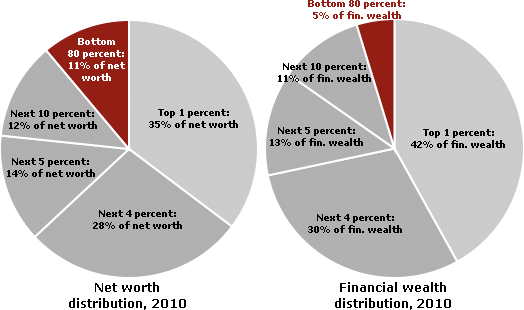
In 2007 in the United States, the top 1% of the population owned 42.7% of the wealth, the next 19% owned 50.3% of the wealth, and the bottom 80% of the population owned a meager 7.0% of the wealth. And for a far more stark picture, the bottom 40% of the population own 0.3% of the wealth.2 And after the financial collapse of 2008-2009, the poor have only gotten poorer.

Generally speaking, if you ask someone in this country what social class they belong too, they say the middle class.3 In fact, 59% claim to be ‘upper middle class’ or ‘middle class,’ while only 39% consider themselves to be ‘working class.’

I’ll give everyone a hint: it’s very likely that on the larger scale, you are poor.

Meanwhile, corporations, whose profits have increased by 39% in 2010, pay little to no taxes. In Wisconsin, two-thirds of corporations pay no taxes, and part of our current budget hole is due to the $117 million corporate tax cut passed by the Republicans.4

Republicans tend to heavily call for the elimination of ‘death tax,’ their hyped-up name for the inheritance tax. The inheritance tax affects only those who received inheritance over $5 million dollars at the federal level, and only 1.6% of Americans receive more than $100,000.5

Taxes have continuously been cut for the wealthy and corporations, more than for the middle class and the poor. The bottom 20% pay 16% of their income in taxes, the next 20% pay 20.5%, the next 20% pay 25.3%, the next 20% pay 28.5%. This makes up the bottom 80% of people.6

Now it gets interesting. The next 10% (making around $100k/year), pay 30.2%, the next 5% pay 31.2%, the next 4% pay 31.6%, and the top 1% of the population, taking in an average of $1.3 million a year, pay a 30.8% income tax. You will note that in the top 19% of the population the increase in the percent of income taxed is almost flat, and that the top 1% pay about the same amount of tax as those making $100k, less than what those just below them pay.7

Why all these numbers? Why the reference to the French Revolution?

To show a few stark realities: ‘trickle down economics’ is a fraudulent policy that aims at consolidating wealth, the United States is driven by capitalism and not democracy, and that the wealthy have been engaging in class warfare for some time already.

The wealthy, including corporations (which according to law and the Supreme Court are people—wait until they have voting rights), are and have been forming a fascist oligarchy. They only care about profit, their wealth, and their power, and they don’t care what happens to the rest of us.

They have waged a war of propaganda, convincing millions of working-class Americans to support them while they strip away rights and increase the financial burden of the poor. They have slowly broken the unions that built this country to limit organized resistance to their advance.

Deregulation led to the current financial collapse, which affects the poor far more than it affects the wealthy. ‘Trickle down economics’ has led to the rich consolidating and becoming richer while the poor become poorer.

With the wide gap in wealth distribution, the demise of unions, the rising price of food8, and the vast expenditures to benefit corporations and the wealthy (labeled as ‘tax cuts,’ not spending), the current situation in the United States reminds me rather much of France in 1789.

The wealthy and the conservatives have been fighting this class war already. Meanwhile, union membership has dropped from 45% of workers in 1950 to 7% today.

Those who are complaining about the benefits and wages of union workers, know this: it is not the unions’ fault, it is yours. You have not organized.

The only way to defeat oligarchy is for the people to fight back. The 80% of this country who are downtrodden and poor need to rise up and declare that the people rule this country, not the wealthy and the corporations.

What we have seen in Tunisia, Egypt, Algeria, Yemen, Bahrain, Libya, Wisconsin, and elsewhere is the realization of people that they hold the power in the social contract. Many of these battles have just begun, and all are far from over.

The wealthy have been waging class warfare for decades, convincing the people that their best interests were served by the wealthy being wealthier.

Now the people have begun to wake up, and it is time for the people to fight.


1 http://www.suite101.com/content/the-estates-general-a51288 Retrieved 2011-2-21.
2 http://sociology.ucsc.edu/whorulesamerica/power/wealth.html Retrieved 2011-2-21.
3 http://www.huffingtonpost.com/2010/03/15/less-than-half-of-america_n_498943.html Retrieved 2011-2-21.
4 http://www.pslweb.org/liberationnews/news/whats-really-at-stake-in.html Retrieved 2011-2-21.
5 http://sociology.ucsc.edu/whorulesamerica/power/wealth.html Retrieved 2011-2-21.
6 ibid.
7 ibid.
8 http://www.bls.gov/news.release/cpi.nr0.htm Retrieved 2011-2-22.

Wednesday, February 16, 2011

“We all have to suffer”


“First they came for the communists,
and I didn't speak out because I wasn't a communist.
Then they came for the trade unionists,
and I didn't speak out because I wasn't a trade unionist.
Then they came for the Jews,
and I didn't speak out because I wasn't a Jew.
Then they came for me
and there was no one left to speak out for me.”
                                       -Martin Niemöller1

I’ve seen many people speak against the protesters and public workers in Wisconsin by saying ‘in this economy we all have to suffer.’

It’s true, we are all suffering. And most public workers (my family included) probably saw the increase in what they pay for their healthcare, pension, and other benefits coming. It was a pretty obvious move for Governor Walker.

This change represents a 7% pay cut for most public employees in Wisconsin2. It is a falsehood that public employees have ‘paid nothing’ for their benefits. Generally speaking, public employees work for far lower wages than a private sector counterpart, and part of the exchange is the improved benefits. You can look at what a teacher makes, and decide for yourself.

And this is not necessarily the ‘only option’ that Governor Walker makes it out to be3. Other states have had similar issues and have come up with different solutions4.

This, however, is not the real issue. The real issue is the undermining of the basic rights of the citizens of this state.

Article 23, Universal Declaration of Human Rights:
(3). Everyone who works has the right to just and favourable remuneration ensuring for himself and his family an existence worthy of human dignity, and supplemented, if necessary, by other means of social protection.
(4). Everyone has the right to form and to join trade unions for the protection of his interests.5

It’s true, Scott Walker is not denying the ability to join a union, but he is taking away the fundamental power that a union has—the power of collective bargaining.

Without collective bargaining, a union only has one big option—to walk out, to strike. And this is not the best option for anyone—the state, the workers, or the people. And by law, public employees are prohibited from striking.6

And if you think that Scott Walker is only coming after the public employees, or that he’s only coming after the unions, you are mistaken.


1 http://en.wikipedia.org/wiki/First_they_came... Retrieved 2011-2-16.
2http://www.nytimes.com/chrome/#/a/http://www.nytimes.com/2011/02/17/us/17wisconsin.html Retrieved 2011-2-16.
3 http://www.politifact.com/wisconsin/statements/2011/feb/15/scott-walker/wisconsin-gov-scott-walker-says-alternative-state-/ Retrieved 2011-2-16.
4 http://www.washingtonpost.com/wp-dyn/content/article/2011/02/15/AR2011021504339.html?hpid=opinionsbox1 Retrieved 2011-2-16.
5 http://www.un.org/en/documents/udhr/index.shtml Retrieved 2011-2-16.
6 http://host.madison.com/article_194318e4-3a2b-11e0-86bd-001cc4c002e0.html Retrieved 2011-2-16.

Protest Resources–Oust Governor Walker


Here are some great resources for everyone to use:

  1. You can call the Governor’s office at 608-266-1212. It will say the voice message box is full. Just keep on the line as long as you can and it should go to a live person. Otherwise, keep trying to call back as you have time.
  2. You can call 1-877-753-5578 to get in touch with your state representatives. Many message boxes are also full here, but keep trying!
  3. NotMyWisconsin is largely a way to sign up for action alerts. scottwalkerwatch.com is another good resource, though it seems to be down right now.
  4. There are many Facebook groups, 540,000 To See Scott Walker out of WI, January 2012 and Recall of Governor Scott Walker seem to be good ones.
  5. My.Madison is a great place to get current local news about the situation.
  6. As an alternative to calling (though calling is what we need right now), you can find out who your state legislators are and their contact, including email will be listed. Please write and keep writing!
  7. Many hashtags are floating around out there for Twitter. Mine is #OustGovWalker, others include #NotMyWI, #WIUnion, #SolidarityWI, and #KillTheBill

Solidarity Forever.

Oust Governor Scott Walker


"There's a time when the operation of the machine becomes so odious—makes you so sick at heart—that you can't take part. You can't even passively take part. And you've got to put your bodies upon the gears and upon the wheels, upon the levers, upon all the apparatus, and you've got to make it stop. And you've got to indicate to the people who run it, to the people who own it that unless you're free, the machine will be prevented from working at all." –Mario Savio1

Solidarity to all those protesting Dictator Walker. We can't take 4 more years of his unilateral actions against the people of his state.

In 1911, Wisconsin became the very first state to enact workers compensation protections. In 1932 Wisconsin was the first state to enact unemployment compensation. And in 1959, Wisconsin was one of the first to enact a collective bargaining law for public employees.2

“Seven killed were on May 5, 1886 by state militia who fired into a crowd of 1,500 workers marching peacefully on behalf of the eight-hour day toward the Bay View Rolling Mills on Milwaukee’s lakefront.”3

Scott Walker has threatened the peaceful protests against his policies with the Wisconsin National Guard. This would be the first time the National Guard would be ordered against the citizens of this nation since 1968.

Scott Walker is a dictator. He enacts sweeping legislation from the executive branch, in violation of his constitutional mandate. When the people cry out against him, he threatens them with military reprisal.

This must end. We cannot lie down and let Scott Walker destroy everything the people of this state have worked for for the last hundred years.

I call upon the people of this state to sign a Recall Petition to oust Governor Scott Walker. Within 60 days of registering such a petition, we would need to gather at least 533,287 signatures.4 I think there’s about 175,000 state and public workers who would be with me.

Unfortunately, we must wait until one year after he took office. In January 2012 I trust that such a petition will be circulated.

In the mean time, do what you can to “put your bodies upon the gears and upon the levers.”

And you must write letters, as many as you can, to your state representatives and to the governor’s office stating your views. Email is okay, but I would much rather flood the mail with letters of outrage against this dictator. On Twitter I am using the tag #OustGovWalker, and I encourage everyone to use it as well.

Solidarity Forever.


1 http://en.wikipedia.org/wiki/Mario_Savio Retrieved 2011-02-16.
2 http://www.wisconsinlaborhistory.org/?page_id=34 Retrieved 2011-02-16.
3 ibid.
4 http://elections.state.wi.us/docview.asp?docid=11827&locid=47 Retrieved 2011-02-16.

Tuesday, January 11, 2011

Top Ten Albums – January 2011


A few months ago I started keeping a mental list of what my favorite albums of all time are. It's a list based on my opinion at the time and also weighted by how often I am listening to that album. It's changed a fair amount over the last few months, and I've thought about how it would be fun to track these trends, especially looking back in the future.

So, both to share what I'm listening to and for my personal historical record, I am starting a new 'feature' on this blog, my top ten albums. Starting with a new year seems like a clean way to go, and installments will be monthly.

Here we go:

  1. A Thousand Suns A Thousand Suns – Linkin Park
  2. This is War This Is War – 30 Seconds to Mars
  3. sing the sorrow Sing the Sorrow – AFI
  4. fallen Fallen – Evanescence
  5. alchemy index air and earth Alchemy Index, Vols. III & IV: Air & Earth – Thrice
  6. 61K13NII61L._SL160_ Siren Song of the Counter Culture – Rise Against
  7. infinity on high Infinity on High – Fall Out Boy
  8. 21st century breakdown 21st Century Breakdown – Green Day
  9. american idiot American Idiot – Green Day
  10. how to start a fire How to Start a Fire – Further Seems Forever

There were some others in the running for the list, but I had to make my decisions. After #5 it became a little more difficult, since I spend a vast amount of time listening to the top albums on the list.

Monday, January 3, 2011

The Math of Dream Time in "Inception"

I'm a big fan of Christopher Nolan's newest film "Inception."


I am also a big fan of math. I know that makes me a nerd. (When I was home for Christmas, my family was discussing complicated gift-giving timetables, and getting confused. So I drew a Venn Diagram where the universe was 'my family,' and gift-giving times were shown as color-coded functions describing the relationships between various parts of the family. I thought it cleared everything up nicely, although my family did not entirely agree.)


So, I decided, with the help of a partner, to try to figure out the Real Time to Dream Time conversion from the movie. I figured at first it would be a nice linear function, but alas, no.


Throwing out the off-the-cuff estimations that are made at various points in the movie, I considered my reliable data points to be:


Real Time 1st Dream 2nd Dream 3rd Dream
5 60 ? ?
600 10080 259200 5256000


This comes from two scenes. In one, they are teaching Ariadne about the dream world, and they say "Five minutes in the real world gives you one hour in the dream world."


The second comes from when they are planning for the flight. They say that the flight is 10 hours, which gives them 1 week in the first dream, 6 months in the second dream, and 10 years in the third dream.


I have converted everything to minutes as our base unit. Given this information, we plotted the second (more complete) set into a curve to predict the final piece of that set, the time in Limbo. We got y = 26.276e3.0481x  with an R2 value of 0.9993.
This gives us a Limbo time value for that set at 109250719, or approximately 39,000 years.


The two data sets don't exactly work together, though. Any equation you find to approximate the relationship does not correctly predict our other given case. This is partly because we are working in 3 dimensions, so we need to define some variables:


  • x is the dream level, given by 0 for real time, 1 for first dream, etc.
  • z is the amount of real time, and
  • y is the amount of dream time.
Then we can say that f(x,z) is the amount of dream time, and we have 
f(x, 600) = 26.276e3.0481x.

We tried very many ways to fit our two data sets together, but we were not finding any good correlations. We are especially interested in the fact that they seem to be able to do the math quickly (or at least estimate quickly) in the movie, and we had not been able to find an elegant equation.

Eventually, we started to think about it another way. What if we graph the amount of real time passed for each minute in dream time, based on the dream level? This gives us a curve approaching zero on the y-axis.

We used our given information to graph this:


Dream LevelReal TimeDream Time
011
11600/10080
21600/259200
31600/5256000
Which gave us this relationship: a = 1.0835e-3.048x
where a is the real time passed for each minute of dream time at dream level x.

I realized that a = z/y, since a is essentially the z per 1y.

So, with some algebra we come up with 

f(x,z) = z/(1.0835e-3.048x)

Now, this is far from perfect, and as an example, in my table below I have a "Real Time" column, which is the real time as predicted by our function. You can see that the accuracy of the real time prediction goes down as real time increases, but that the prediction of dream time values gets more accurate as we approach our base case of 600 minutes real time. Also, "Real Time" is rounded to two decimal places, and the dream time minutes are rounded to the whole number.


You can see, though, that we are still off from our given values:


I am very interested in whether or not someone can come up with a better approximation than ours, and I'd love to see it.


Probably will be more on this to come.

Friday, October 8, 2010

Veggie Stew Recipe

To celebrate having a new stove and dishwasher, marking the first time we could cook at home for about 2 months, I made some stew. Some of my friends know of this stew. This time, especially after some persuading from others, I have decided to write down a recipe. So here it is. 


The measurements may be a little rough, but stew is pretty lenient. Also, it is worth noting that this is my super-easy "semi-home-made" version of this. When I'm feeling up to it, I'll cut up and otherwise prepare a whole bucket o' fresh veggies. However, this is almost as good at about 1/10th the effort.


1 14.5oz can of vegetable broth
1 14.5oz can of sweet corn
1 14.5oz can of peas
1 14.5oz can of sliced carrots
1 14.5oz can of garbanzo beans (chickpeas)
1/2 or 1 can of pinto beans
2 14.5oz cans of 'new/baby' potatoes
1 14.5oz can of diced tomatoes
1 large (30oz?) can of tomato sauce
1 cup frozen (or fresh) mukimame (shelled edamame)
1/2 cup uncooked 'minute' brown rice
1 cup frozen diced onion OR 1 medium white onion
1 tbsp diced garlic (2 large cloves)
1 tsp Mirin
1 dash of 'Italian seasoning'
2 tsp of chili powder
2 tsp or more of cayenne pepper, to taste
1 tsp or more ground black pepper, to taste


*Note: get the reduced salt or no salt canned vegetables whenever possible. Also to avoid: the cheapest can. It's never worth it. Get your green giant or del monte or whatever and enjoy it. You can spare the extra $1.50 total.


  1. Heat a large stockpot on a med-high burner. Once it's warmed up, add about a tablespoon of whatever lubrication you prefer. All I had on hand at the time was seasoned wok oil, which worked great. Olive oil would work great too.
  2. Add the onion, sauté until translucent. Add the garlic as the onions are just starting to turn. You don't want to burn the garlic. 
  3. At around the same time as the garlic, add your mukimame. If you are using fresh or thawed, add them a little later. If you're confused about this whole mukimame/edamame thing: soybeans. Soybeans out of the shell. That's what I'm talking about.
  4. You want the mukimame to get just a little bit of brown to some of them. This helps make them a little chewy later, which is delicious. The onions can be a little brown in places, but generally translucent.
  5. Before anything starts to burn (or if it does), add the whole can of veggie broth and stir it up to get any goodies off the bottom of the pot. (Deglazing, sort of)
  6. At this point, add the corn, peas, carrots, garbanzo beans, pinto beans, and potatoes. Make sure to drain each can first. Some bean juice is not just okay but good. For the potatoes, you'll need to cut out any eyes that escaped the machines and slice the potatoes into roughly bite-sized chunks before you add them. One benefit of using canned potatoes is that you can leave larger chunks and they will still cook through, as they are already par-cooked.
  7. Add the spices and the Mirin. Stir thoroughly.
  8. Bring to a low boil, then cover and reduce temperature to simmer. Simmer for 15-20 minutes, stirring occasionally. 
  9. Add the rice. Stir. I used about 5 'small handfuls' of rice, so I'm estimating 1/2 to 1 cup, uncooked. Use 'minute' rice.
  10. Add the diced tomatoes and tomato sauce. Stir thoroughly.
  11. Bring back to a simmer. Cover and simmer for 50 minutes, stirring occasionally.
  12. Enjoy!

Monday, September 27, 2010

Wildlife Photography

Wildlife and nature photography is something I'm interested in, in an amateur fashion. I got a zoom lens (75-300mm) recently and hadn't really used it yet. I started to take a walk in the park the other day and noticed the copious amounts of cool birds in the marsh, so I ran back home, grabbed my camera and gear, and went back.


Now, this was my first real use of my new lens, and I'm still learning the basics of photography to begin with. Also, most of my good pictures so far have been of .. flowers. Because they're pretty, and they don't move too much.


Birds are also pretty, but damn do they move around.


You know all those sayings about how mistakes are really lessons? I learned a lot of lessons. Took a lot of pictures. Only a few of them are good. But I learned a lot of lessons.


Lessons Learned: Day 1
  • It's true that a zoom lens is hard to keep steady for your picture. A tripod, however, is not an option. I learned this over and over again when things happened and I couldn't get my camera around in time. Folding up some of the legs to make it a monopod was great, I wish I had been doing that from the beginning.
  • A zoom lens has a really narrow focus field. And so, you should always take at least 3 pictures of a great subject, and adjust the focus a little each time (a little too near, what you think is right, and a little too far). That way you increase your chances of one being right.
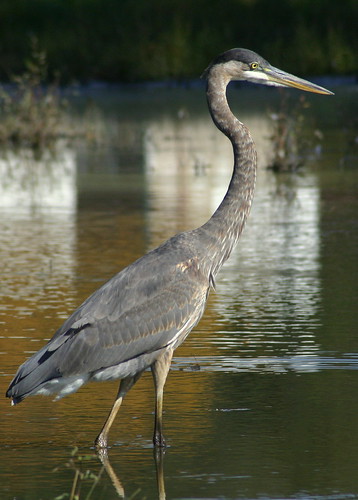
  • It's fairly easy to get close to geese (although they slowly swim away from you), but it's really hard to get close to this guy:


  • I learned how to recognize (via the sounds they are making) that a group of geese is about to take off from the water. This is crucial if you want to be ready to take a picture of them taking off.
  • I also learned to recognize the call of a sandhill crane. This happened when three of them flew literally ten feet above my head and I was not ready for them. Perfect shot missed.
  • It pays to hide. Perhaps I need to invest in some more camouflaged, or at least earth-toned, clothing.
  • Try not to get fuzzy vegetation in the foreground. You may be zoomed all the way to 300, but you still need to know what's right in front of you. You can only crop out so much.
  • Ultimately, I'll need an even bigger zoom lens.
  • A zoom lens is not for taking landscapes with. You cannot get a big enough focal plane.
See all my pictures from day one here.

Lessons Learned: Day 2
So, having learned many things (and more than I listed) on the first day, I returned again this morning in better light and better conditions.

  • Go on a weekday morning. Nobody else is in the park to scare the animals, the lighting is better, and most of the birds are busy eating, so they don't care as much if you're there.
  • Stalk slowly. Basically, you are playing a game of red-light-green-light. If they look away, feel free to run to a new spot, quietly. You will be rewarded:


  • Walk softly. I was clomping my way along to the next spot I was going to take photos from when I saw three turtles slip into the water after I startled them. I could have had some great photographs of them if I had been walking more quietly and paying more attention to my surroundings.
  • When sneaking up on an animal, don't keep yourself below the brush line and then suddenly appear right next to it. I got close, but if anyone was in the park this morning and wondered why about a hundred birds suddenly took off from the shoreline and went out to the middle of the lake: that was my fault.
  • Sandhill cranes really don't want to be photographed.
  • I need a bird identification book. And some binoculars.

I had a lot of fun, and I'm going to keep trying. I'll probably need to pick up some more supplies and check out some books from the library for pointers. If I get some really good shots, or learn some really good lessons, I'll let you know here.

Tuesday, July 13, 2010

The Car Saga

Chapter 1: The tale of how the Corolla came to be


So, about 2 years ago I bought my first car. It was during the super gas price days, when it regularly hit $4 a gallon, so finding an economy car was very difficult. I ended up with my swank 1999 Toyota Corolla, which was exactly what I was looking for, so I overlooked some of the minor concerns we had with it. (It has paint issues, it shook on the highway, dent in the hood, looks like it was treated unkindly.) Bought it for about $4500, after we talked them down a grand. The day after I bought the car and happily drove it back to Madison, the check engine light came on. The dealership was good enough to take it back, check it out, and fix whatever it was for free, as I had literally just bought it. It turned out to be a faulty sensor, no big deal. I should have taken it as an omen, though.


Sunday, March 7, 2010

Aggressive Self-Defense: The Morality of Killing in War

The following was originally written in an ethics class in 2007, and I have made some minor edits. Enjoy.


War is an oft-discussed topic in America right now. People discuss how many deaths there have been on each side, and how the objectives are progressing (or how they are not), and various other details that interest the citizens of a nation at war—for everyone has a vested interest while their country is at war. Of course, another hot topic for debate is the justification for the current war in Iraq. Various politicians, journalists, and celebrities have weighed in on the political, social, and moral justifications for the war. But one debate about war has been simmering for a long time and lies at the heart of past and present anti-war movements: can war be justified at all? Justification for war can come from many angles, but one must eventually examine the core issue—that of the justness of killing in war. A lot of debate has gone into who it is permissible to kill: combatants, non-combatants, guilty persons, innocent bystanders; and there have been many arguments on just how to define those groups of people. Most of all, people have long debated by what principles killing for god or country can be justified morally. None of these justifications, however, provide a satisfactory moral case for just killing in war, and as such, they are not sufficient to justify war itself.


I have chosen two articles with differing views on the morality of killing in war (though they both think it is morally permissible, the justifications and lines drawn are distinct). The first is Robert K. Fullinwider's War and Innocence1 and the second is Lawrence A. Alexander's Self-Defense and the Killing of Noncombatants2, which is a direct reply to Fullinwider. First I will examine Fullinwider's somewhat simpler argument before diving into Alexander's response, which is a more complex model based on Fullinwider's original. After that, I will give my own reasons for which killing should be (and can be) avoided in general.

First, we must set up the thought experiment on which Fullinwider, Alexander, and I are working. This stars the ubiquitous Smith and Jones, and the basic example is the following:
Jones is walking down a street. Smith steps from behind the corner of a nearby building and begins to fire a gun at Jones, with the appearance of deliberate intent to kill Jones. Surrounded by buildings, Jones is afforded no means of escape. Jones, who is carrying a gun himself, shoots at Smith and kills him.3


Thursday, October 29, 2009

Rare Earth Hypothesis vs. Reason

As you probably have gleaned from the title of this post, I disagree with the Rare Earth hypothesis-- that is, the theory that the spectacular coincidences and conditions that led to complex (not even necessarily intelligent) life on this planet is so statistically remote that it is extremely unlikely that any other planet in the universe has evolved complex life. The term (and hypothesis) comes from a book by Peter Ward and Donald Brownlee.

Now, I have not read this book, and therefore I am not fully versed in their arguments. I plan to read the book and make a more detailed argument, but I wanted to lay down my base hypothesis first. Also, Wikipedia does an ok job at summarizing their argument.

So, before we get to their equation, let's look over some data:
  • It is estimated that there are 200-400 billion stars in the Milky Way Galaxy.
  • It is estimated that there are about 100 billion (1011) galaxies in the universe.
  • Galaxies tend to contain between ten million (107) and one trillion (1012) stars.
Now let's crunch those numbers. With simple math, we can conclude that the average galaxy has 109.5 stars. So, to calculate the total number of stars in the universe we need 1011 * 109.5, which gives us, with rounding, 1020 stars. (That's 100,000,000,000,000,000,000 stars.) That's a lot. If each star was the size of a tennis ball, stacked up they could reach the moon from the earth (avg. distance) almost 17.5 million times.

Now let's make some guesses. In the famous Drake Equation, it is estimated that half of all stars will have planets. So that gives us a more manageable number of 1010 stars with planets. For the sake of argument, let's say that our solar system is fairly typical, and maybe the average number of planets in a solar system is around 6. I think I am being generous to the Rare Earth-ists here, as a solar system could easily have tens of planets, not to mention life-supporting moons. That gives us 6 * 1010 planets in the universe. Disregarding the Drake estimate of 2 planets per star supporting life, let's say that, I don't know, 1/8 of planets support complex life.

So, we have finally arrived: 60,000,000,000 planets could support life. Sixty billion seems to be far from the estimate of 1. If my estimates have an error of 99.9%, there would still be 7,492,500,000 planets supporting complex life. Of course, some of that may have died off already, and most (statistically) we would never be able to find. (If you read the numbers above, and you're good with visualization, you should already have realized the size of the haystack in which we are searching for a proverbial, uh, 60 billion needles.)


As I have said, I will in fact be making a more detailed argument later. However, I assert that the vast immensity of the universe makes the Rare Earth theory extremely unlikely, statistically. And I haven't even broached the subject of carbon-based vs. non-carbon-based life or the general assumptions of what a 'life-supporting planet' requires.

QED.


Friday, October 9, 2009

Barack Obama Deserves the Peace Prize

I, like many others, was a little surprised by the news that Barack Obama was named the winner of the 2009 Nobel Peace Prize. Many people's reaction has been, "But what has he done?"

I will tell you, in the form of the press release from the Nobel Prize Committee:

The Norwegian Nobel Committee has decided that the Nobel Peace Prize for 2009 is to be awarded to President Barack Obama for his extraordinary efforts to strengthen international diplomacy and cooperation between peoples. The Committee has attached special importance to Obama's vision of and work for a world without nuclear weapons.

Obama has as President created a new climate in international politics. Multilateral diplomacy has regained a central position, with emphasis on the role that the United Nations and other international institutions can play. Dialogue and negotiations are preferred as instruments for resolving even the most difficult international conflicts. The vision of a world free from nuclear arms has powerfully stimulated disarmament and arms control negotiations. Thanks to Obama's initiative, the USA is now playing a more constructive role in meeting the great climatic challenges the world is confronting. Democracy and human rights are to be strengthened.

Only very rarely has a person to the same extent as Obama captured the world's attention and given its people hope for a better future. His diplomacy is founded in the concept that those who are to lead the world must do so on the basis of values and attitudes that are shared by the majority of the world's population.

For 108 years, the Norwegian Nobel Committee has sought to stimulate precisely that international policy and those attitudes for which Obama is now the world's leading spokesman. The Committee endorses Obama's appeal that "Now is the time for all of us to take our share of responsibility for a global response to global challenges."

So, in the words of the committee itself, they awarded the Peace Prize to Mr. Obama for making substantial gains in the diplomatic process, giving people hope, and beginning work towards various peaceful goals, including nuclear disarmament.

Let me step away from achievements, for a moment, to answer another fast criticism of this award. Many have pointed out that the nominations for this prize were due to be postmarked by Feb. 1st, 2009, exactly 12 days after the President took office. So, people have concluded (erroneously) that Mr. Obama received this award before taking virtually any steps as President of the United States. I would like to point out to the world that a nomination is only a nomination. Obviously, someone had high hopes for what Mr. Obama could accomplish in this year, and yes, maybe they submitted the nomination for political reasons. However, I assert that the Nobel Prize Committee is not peopled by idiots or fanboys. I have extremely high respect for their organization, and I hope that you do too.

The Nobel Peace Prize, from the will of Mr. Nobel himself, is to be given to "the person who shall have done the most or the best work for fraternity between nations, for the abolition or reduction of standing armies and for the holding and promotion of peace congresses." The Prize committee, in making its decision, was looking into the last 8 months of the presidency, and not the first 12 days. There were very many nominations for this prize, in fact the most nominations ever. I assert that if they believed that Mr. Obama had not made progress promoting "fraternity between nations" etc. they would have picked one of the other 204 nominees. The list is secret for the next 50 years, but I think we can trust there were some good names on it.

So, has President Obama signed a large peace accord, as President Wilson did before winning the 1919 Nobel Peace Prize? No. Did he help to negotiate peace between two major countries at war, as President Roosevelt did to win the 1906 Nobel Peace Prize? No. I believe, however, that he has made great strides in promoting "fraternity between nations," at the least.

In very short order, President Obama changed the foreign policy of the United States from strong-arm unilateralism to broad-based diplomacy. He immediately appointed important envoys and began new peace talks, including being the first President to open meaningful peace talks with Iran, which, although rocky and far from over, have dramatically improved the relationship between our countries. He made steps to bring our country back under the codes of conduct laid out in the Geneva Convention. He restarted nuclear disarmament talks with Russia, this time, unlike his predecessors, negotiating for a stronger reduction. He paid our debt to and reopened meaningful interaction with the United Nations. And he told the world that not only would we not take unilateral actions, but that we also require the aid of other countries in order to move forward towards peace and disarmament.

Perhaps, in this great century, the people need a flashy achievement. The 2009 Physics Prize, essentially awarded for the invention of fiber optic communication, is pretty cool, as well as immediately tangible. Peace, however, is rarely flashy. Peace is shaped through long negotiation, nurtured by building trusting relationships with sovereign nations, and enacted through policy change.

I do not deny the unbelievable work of people who, every day, all over the world, are working in immediately tangible ways to improve life and promote peace. Yes, these people are extremely deserving of praise. When you look at the wording and the purpose of this particular recognition, however, you find a description of the 'big picture.' Without belittling the work of so many, this particular prize exists for a different reason.

The Nobel Prize Committee, and the Nobel Prizes themselves, exist to encourage and inspire as much as they exist to reward notable achievements. Countless times they have been awarded for progress, and progress surely has been made.

Mr. Obama said this morning that he did not feel he deserved the prize. Mr. President, I must respectfully disagree. Your contribution to the global peace process is already irrefutable, brought forth largely from a willingness to talk and to listen, and to treat other nations with their due respect. You have brought hope to not only the millions in your country, but to billions around the world. We see you as a leader who one day may bring to this Earth a new era, and we hope. Where once we saw immovable obstacles, you have changed the international political dynamic to be a place where diplomacy and cooperation can work.

Mr. President, on behalf of myself, and others whose voices may not be heard this day, I thank you for all you have done already, and I look forward to watching you change the world.

Friday, September 11, 2009

Damn Small Linux... still foiling my install


Here's a picture of my Xybernaut MA-V previously posted about, currently hooked up to a desktop monitor. I am still trying to find a compatible HMD, but I have a lot of setup to do before I'm ready for it anyway. You can see the wrist-size keyboard there, though, which is pretty sweet.

Currently, I am attempting to install Damn Small Linux, which is giving me some trouble. The OS is designed to run on a LiveCD or USB thumb drive, etc. so getting it to reside on my hard drive is proving difficult, despite DSL having at least three separate ways to do just that. Despite having the USB external CD drive listed as my first boot device, the computer has problems booting into DSL, without which I cannot work on partitioning my hard drive for Linux, or perform the install itself. For some reason, when I ran cfdisk the first time, and thought that I had successfully partitioned the drive, I rebooted the computer to find myself back in Windows. Now, when I try to boot back into the DSL LiveCD, it isn't letting me.

For now, as I am on vacation, this project is sitting still, but when I get back to it next week, and hopefully finally get DSL running on the hard drive, I can really get started and I will definitely keep you all up to date.

Monday, August 31, 2009

Green Goods

After watching a Frontline episode about the state of water quality, I decided I needed to put more action to my thoughts and begin to revamp how I live my life, so I have been changing over to some of the new 'green' products on the market. These products fill a new and rapidly increasing market, and I have heard that some "don't do anything" and some are the next best thing. So, I thought I'd take you along on my journey by sharing my experiences with the products I have been using.

Most of these are being bought as I run out of other things, so it is in a fairly random order. Also, we all know about CFLs, and we all should be using them, so I won't bother to beat that subject to death. (Although I await consumer LED lamps with bated breath...)

Sturdi
® Degradables
These trash bags come in your normal kitchen-size as well as ubiquitous black trash bag and lawn/leaf. They claim to be 100% degradable, as in, they will break down over time, mostly due to interaction with light. Not quite as cool as fully biodegradable bags would be, but a step in the right direction. These bags don't have any of those fancy 'technologies' of the bigger brands, but they are just as robust as any other trash bag I've ever used.
My rating: 5/5

TerraCycle™ All Purpose Cleaner
A great product from a great company. This cleaner works great for every day use, and is completely non-toxic and packaged in what they call "waste-stream" packaging. Essentially, your bottle of cleaner once was a liter bottle of something else, and the spray cap was a spray cap to something else as well. I have been using this to clean sticky messes up off my kitchen counter (non-toxic, remember?), and it works great, especially if you give it about 10 seconds to soak for a big mess. For example, the very first thing I used it on was a big gob of honey that had spilled down the side of my honey jar and coalesced on the counter. Being a chore to clean up, it sat there for 2-3 days (I know, I know). First I sprayed cleaner on and tried to wipe immediately to limited success, but then I sprayed a bit on, let it sit for about 15 seconds, and wiped the whole mess up with my (biodegradable) sponge in one go. The only downside is that, like other cleaners, it doesn't smell so great, but at least it isn't caustic-bleach-smell. This company also offers a bathroom cleaner that I have not yet tried.
My rating: 5/5

Scotch-Brite™ biodegradable absorbent sponges
I got these sponges to lessen the amount of paper towels I use. They pretty much seem like your average traditional sponge, except that, being made from recycled paper, they will biodegrade once I throw them away. I have found them to be dead useful, and even if they start to break apart a little sooner than their cousins (which they do), I personally don't want to keep a sponge for years anyway. You can find the whole range of products here. I have only used the above-mentioned sponges, but I plan on using the others as well.
My rating: 4/5


Ecos Free & Clear Liquid Laundry Detergent

After being a long-time Tide user, I've switched over to this detergent. I chose the free & clear version with no dyes or scents, since I think both of those are superfluous in something you are going to pour down the drain. (I don't buy detergent to look at or smell...) So far it has been working great, even on my work-shirts that get various grime, grease and dirt on them. I was always a fan of the 'bleach-alternative' Tide products, so my only disappointment is the slightly reduced function on bad stains. However, since these are probably in the minority of your laundry, grab a stain stick or spray and you should be set to go.
My rating: 4/5


Method
® gel hand wash refill
Again, I chose the 'free of dyes + perfumes' (a.k.a. 'go naked') version for basically the same reason as above. Also, though, I didn't like the two other scents that were available at that particular retailer. This soap is everything you expect from a soap, and is not antibacterial, which, if you are not in a hospital, clinic, or nursing home, you probably don't need. It's another topic, but antibacterial soaps are a very, very bad thing, so trust me here. The refills also come in these sweet pouches that the manufacturer claims allows an "83% savings in plastic, water + energy." I'm all for it.
My rating: 5/5


Method
® all surface wipes
Same 'go naked' version as the soap above. I like the advent of these cleaning wipes, and now I can get them in a greener version. Generally, it is better to use a reusable cloth and a bottle of spray, but sometimes you have something to clean up that you'd rather not keep around, or you need the portability the wipes offer. And at least these are "compostable" and made with eco-friendly cleaning agents. The wipes are made from bamboo, and the packaging is also minimized. Sometimes the lid can leak air a little, though, causing your wipes to begin to dry out, so make sure you snap it tight, or maybe put the bag inside another bag for long-term storage.
My rating: 4/5

That's all for now. I have a few other things I am currently using, and I plan on continuing to pursue these products further, so I will have more suggestions and reviews later on. Let me know what you think or suggest other products for me to try by leaving a comment.


Note: I have not, in any way, been reimbursed for any of these reviews by any company or person. These are purely my opinions. All product names are registered trademarks of their respective manufacturers.